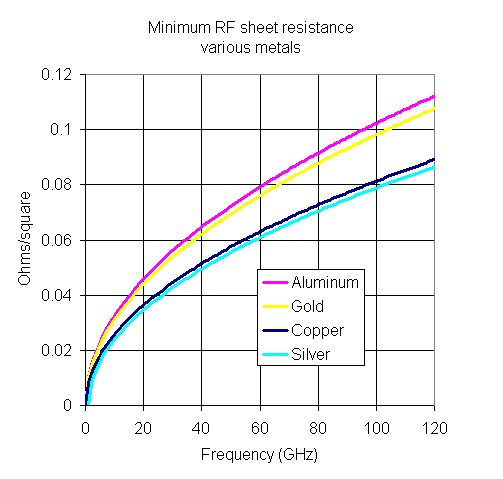
It is a measure of the lateral resistance through a thin square of material i e.
Surface resistivity of copper sheet.
The resistance between opposite sides of a square.
For example it will be seen that the resistivity of copper the resistivity of aluminium and that of silver and gold determines where these metals are used.
It is also possible to work out the resistance along another dimension.
This is the origin of the very simple rule of thumb that.
Surface resistivity is a property of a material.
The electrical resistivity is particularly important because it will determine its electrical performance and hence whether it is suitable for use in many electrical components.
The thickness of 1oz copper foil is about 34µm or 1 4 mils.
According to surface resistivity.
At one skin depth the metal s conductivity has been reduced to 36 8 of at 2 skin depths 13 5 etc.
The sheet resistance of 1 oz copper is 0 5 mohm sq.
Surface resistivity ρs on the other hand is deter mined by the ratio of dc voltage u drop per unit length l to the surface current is per unit width d.
It is commonly used to characterize materials made by semiconductor doping metal deposition resistive paste printing and glass coating examples of these processes are.
Make a note of this value making sure that it has been done so in meters.
We can tell you that the resistivity of copper is 1 72x10 8 ohmmeters.
Basic setup for surface resistance and surface resistivity measurement.
The sensing materials that are shown in the following graphs come from each end of the surface resistivity range.
The sheet resistance of 1 oz copper foil is 0 5mω square.
This makes the sheet resistance of 1oz copper foil about.
Sheet resistance often called sheet resistivity is a measure of resistance of thin films that are nominally uniform in thickness.
Typically you d reference sheet resistance in terms of a material with a thickness.
If the triboelectric charging of.
At the surface complete conduction takes place and the resistivity of the metal is 100 of its value at dc equal to.
Multiply the resistivity of copper by the length of the object.
By the time you reach five skin depths the metal s conductivity is reduced to just 0 7 of its full value.
ρs u l is d 2 l d u electrodes material figure 1.
8 9 b where the corrected resistivity data of the deposits against plating time are illustrated the lowest resistivity of the deposits is about 0 5 μω cm which is lower than the bulk resistivity of copper.
The known resistivity of bulk copper is 1 68 μω cm.
A conductor copper was used as the sensing material in the first graph and an insulator ptfe was used as the sensing material in the second graph.